Farmlands, or agricultural landscapes, captures the interest of a number of researchers based at the Department of Human Geography, Stockholm University. On this blog we share information about research findings, activities, events and comments related to our work.

Our interest in farmlands has three roots: farming, landscape and society.
Farming as a practice, including farmers knowledge and labour investments
Landscape as society-nature relations, congealed history, and as space and place
Society as a short form for institutions, gender relations, political economy and scientific relevance

Most Welcome to FarmLandS!

Wednesday, January 27, 2016

Bokoni terracing -- in press


Terraces at Rietvlei, south of Machadodorp
The precolonial agricultural terracing in the Bokoni area in Mpumalanga is impressive and a clear example of investments in landesque capital. It is easy to envisage all this terracing as needing a concerted labour effort so that terracing has to be concluded before farming can start. In 2009 Alex Schoeman and I did get money for Swedish-Research Links to start a cooperative project on Bokoni and during the first brainstorming field trip in 2010 a group Swedish geographers were shown around by Alex in the area between Orighstad and Carolina and started to get an impression. We discussed the possiblity of better understanding the process of terrace building and were lucky to be able to continue an already started excavation of a flight of terraces at Verlorenkloof to find out more. The team now finally reports on this in a recently accepted paper Precolonial agricultural terracing in Bokoni, for Journal of African Archaeology.


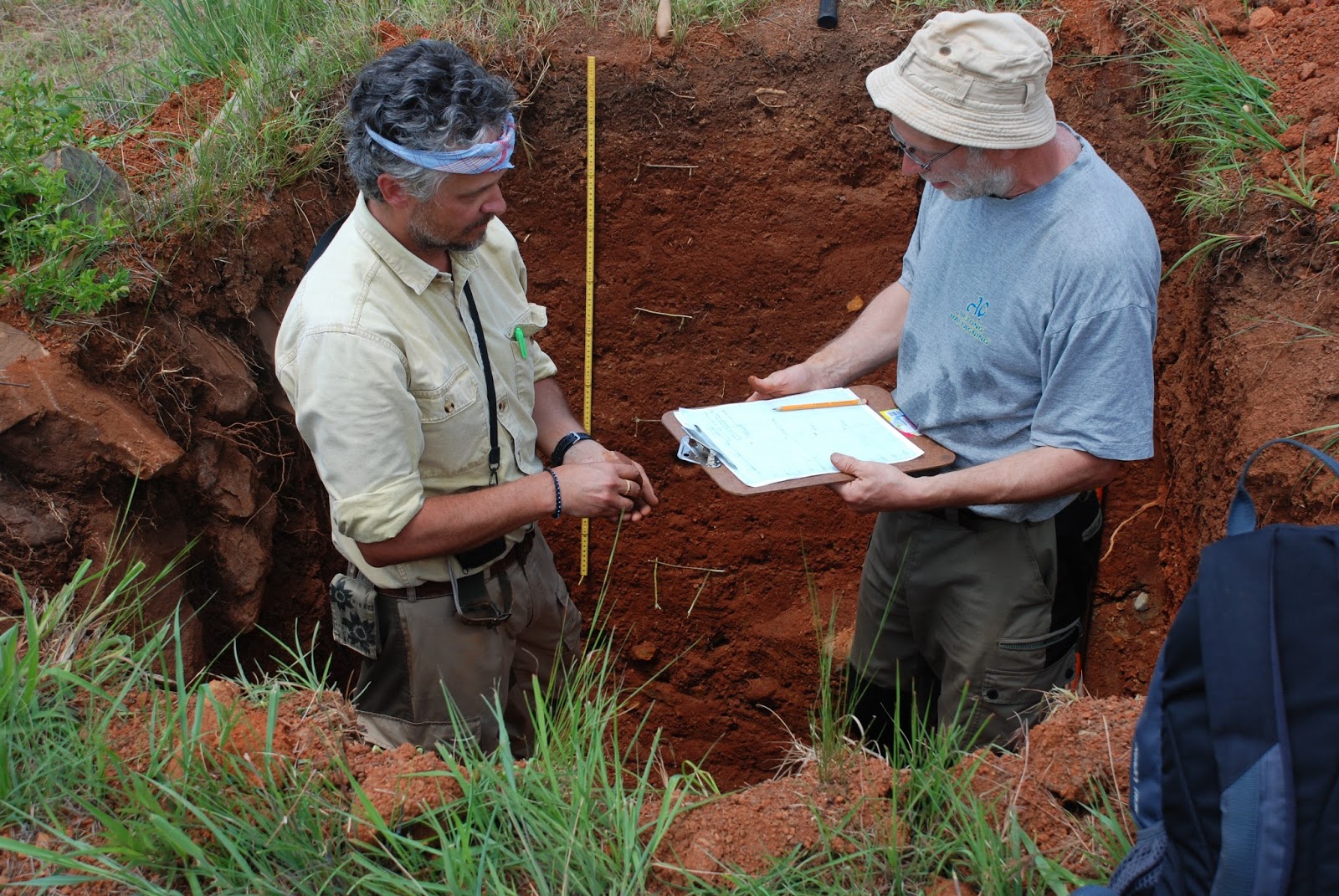
The upper part of the terrace wall was initially constructed only as line of slabs set down in the soil to prevent erosions. Tim Maggs documenting the construction.

Lasse Westerberg and Jan Risberg documenting the character of the accumulation of soil in the terraces.

Cross-shaped phytoliths were found in the terrace accumulation. Maize produces cross-shaped phytoliths, but they could also emanate from wild grasses, so until statistical tests have been done they can only be seen as a possible indication of maize cultivation.


Tim Magg's drawing of the incremental development of terracing at Verlorenkloof


In short we argue on the basis of this evidence that the building of terraces in Bokoni must have been incremental. As more land was taken into cultivation, stone clearing increased. The stones were used in constructing erosion controlling stone lines that eventually developed into fully fledged terrace walls.

Read more::

Thursday, December 3, 2015

When different needs, "worlds apart", meet in the field: Reflections from a PhD student and mother.


In 2009 I was off to my first field trip in Africa. A preparation workshop introduced us, a handful of master students, to participatory methods. Since then, focus groups, participant observations, and unstructured interviews have become an important part of my data collection repertoire. In combination with structured livelihood interviews, these methods have provided me with a good insight into households in rural Niger and lately also in rural Mozambique.

My experience does not allow me to call these methods what many researchers do: rapid. All that is said in a meeting must be acknowledged as single perceptions. Assessing common perception (or maybe facts?) usually requires a great deal of time. The insights provided by one group is double checked with groups of similar composition and cross-checked with different groups.

The more time you spend with your respondents, informants, participants, the more you learn about their lives, the smaller is the distance that separates you. “They there” slowly approaches “us here”. Participatory methods, by allowing “them” to guide you, the facilitator, into their world constitute a powerful tool in this approximation.

In combination with open-ended participatory methods, I often rely on structured livelihood interviews. How much land is used by the household members? How many ruminants are owned? What are the main crops? What are the income sources? Which skills are detained by the household members? These, and a series of similar questions, are posed in attempt to estimate the various resource basis that could be drawn upon in pursue of different livelihood alternatives. I usually interview one adult household member at each time, in order to allow them to answer without interference from others. Once individual interviews have been conducted, group household groups follow and tend to enrich each other’s stories and answers.

I have relied on this set repertoire for collecting what I hold to be qualitative unstructured data and also qualitative structured data in some of the poorest regions of the world. Out of the 187 countries ranked by UNDP’s Human Development Index in 2014, Niger and Mozambique lie at the bottom, Mozambique at the 178th position and Niger at the absolute last 187th position. If we add into consideration the fact that my research has been in rural areas, the general urban development bias gives an idea of just how deprived my informants were.

Finding out that a single mother with five young children had nothing but a quarter of a hectare that hardly sufficed to feed them was common place. Too little rain, too much rain, sickness, crop pests, every unpredictable although not uncommon event reminded them of just how vulnerable their lives were. I listened carefully, reminded myself that I am a student, a researcher, not an aid worker, and noted their answers: male, female, elder, younger, richer, poorer, less or more vulnerable according to my classification.

Back home I processing the data, often with distressing thoughts. My informants are so generous, they share their time and so many aspects of their lives and livelihoods with me, I know that deep inside they hope I may be of some help. When we speak the same language and share the same jokes, their hopes become less implicit, and distances must be reviewed: close enough to collect good data, and far enough to remain in the researcher’s position.

The problem is, and my reason for writing this text, that I am no longer only a researcher, I am a mother. I have a little daughter who must eat, and sleep, who needs a clean and safe environment and clean water to bathe, who has received a first round of vaccination, and has been to the hospital already a couple of times. And now that I have her, I think of all the parents that I have come across, women that went through their pregnancy without any medical assistance, babies that were born to undernourished mothers, to homes without water and proper toilets, where food is scarce, and where medical care is rare. As I look at my baby sleeping, I wonder if I will be able use the same methods and listen to similar stories when I now can feel the consequences of what they are telling me. Will I be able to ask, listen, note, and move to next question? I wonder if the other researchers I have met in the field have understood the consequences of their respondents’ stories. We have all listened to them, and noted that their endurance is a proof of just how resilient they are! But I question whether the majority of us has understood them, particularly those storming through selected sites applying “rapid” methods.

I think that now I understand. And, although becoming a mother is probably not a sine qua non condition to feel empathy towards others’ sons and daughters, it is what has led me to realize that in any point of time their deprivation is incommensurably larger than my research objectives; that, when we meet, their needs are far more vital than mine! How to conciliate these “needs” so dramatically apart?

Maybe the following suggestions can help... 1) To reflect with empathy: taking the time to reflect over activities… what are the consequences of these to the respondents? How sensitive is the information we really need to know? More sensitive information should requires more time, less structure, and more empathy; 2) To allow for changes: How opened to changes in our own planning have we been? Even if these changes may not seem “productive” to our own researches, can we accept them when they derive from respondents’ initiatives and inputs? When respondents lead the activities and discussions, these are usually more meaningful to them. 3) To try to give back throughout: regardless of what the research is about (even if the plan is to publish a master piece paper explaining how to eradicate poverty!), why should we wait for our research recommendations to be implemented instead of giving back throughout the research process? A meaningful moment, new information, a new critical thought, or even a larger contact network with persons and organizations known by us can be of important value. What are we giving and what could we give that may be of value to them (without harming future research in the area?)?

Although the researcher will continue a researcher and won’t become an aid worker, we must talk more about the responsibilities that emerge once persons “worlds apart” meet. When we, after eventually obtaining a formal ethical approval, go on implementing subscribed methods without reflection, the researchers’ agenda prevail, and power relations are reinforced and perpetuated with a cynical silence. Tring to be more sensitive, opened, flexible and generous will hopefully allow me to continue doing field work. I think that, after so many years of development research and still so little change in the most vulnerable “field sites”, it is still and always time for us to engage in renewed self-critical reflection.

What are your thoughts on these issues? Are you a formal adept of “Action Research” or similar methodology? Have you reflected about your eventual responsibility towards your respondents? Are you satisfied with how you have conducted field work? Do you have suggestions or reflections to share with us who were/are (or have never been!) struggling with distressing thoughts of unfair relations in the field?


Tuesday, December 1, 2015

Two new methodological publications

Re-Thinking the Boundaries of the Focus Group: A Reflexive Analysis on the Use and Legitimacy of Group Methodologies in Qualitative Research

by Martina Angela Caretta and Elena Vacchelli
Stockholm University; Middlesex University
<http://www.socresonline.org.uk/20/4/13.html>
Sociological Research Online, 20 (4), 13


Abstract
  1. This article aims at problematizing the boundaries of what counts as focus group and in so doing it identifies some continuity between focus group and workshop, especially when it comes to arts informed and activity laden focus groups. The workshop[1] is often marginalized as a legitimate method for qualitative data collection outside PAR (Participatory Action Research)-based methodologies. Using examples from our research projects in East Africa and in London we argue that there are areas of overlap between these two methods, yet we tend to use concepts and definitions associated with focus groups because of the lack of visibility of workshops in qualitative research methods academic literature.

The article argues that focus groups and workshops present a series of intertwined features resulting in a blending of the two which needs further exploration. In problematizing the boundaries of focus groups and recognizing the increasing usage of art-based and activity-based processes for the production of qualitative data during focus groups, we argue that focus groups and workshop are increasingly converging. We use a specifically feminist epistemology in order to critically unveil the myth around the non-hierarchical nature of consensus and group interaction during focus group discussions and other multi-vocal qualitative methods and contend that more methodological research should be carried out on the workshop as a legitimate qualitative data collection technique situated outside the cycle of action research.

Keywords: Focus Group Discussion, Workshop, Participation, Feminist Critical Research

Member checking: A feminist participatory analysis of the use of preliminary results pamphlets in cross-cultural, cross-language research


Participation and reflexivity have become buzzwords that are seldom discussed in terms of their practical employment. Against this backdrop, with a specific focus on geography, this article presents and analyzes the advantages and limitations of a methodological tool that seeks to enhance both reflexivity and participation. The tool was a pamphlet written in local languages that contained several pictures and summarized the data gathered in previous fieldwork sessions. This tool was used in a four-year research project on the gender division of labor in smallholder irrigation farming in Kenya and Tanzania. The pamphlet showed participants their contributions to the research process and offered them the opportunity to correct, improve and further discuss previously collected data. It not only ensured research validity but also allowed for a shift in the research power hierarchy. Finally, the pamphlet effectively created a space for inclusion, discussion and reciprocal learning, leading to collective reflexivity and catalytic validity by empowering participants and re-orienting the researcher.

Keywords: cross-cultural research, cross-language research, East Africa, feminist epistemology, member checking, pamphlets, smallholder farming

Monday, November 16, 2015

Participatory Checking and the Temporality of Landscapes

New publication
 
Participatory Checking and the Temporality of Landscapes: Increasing Trust and Relevance in Qualitative Research
Camilla Årlin, Lowe Börjeson, and Wilhelm Östberg

The Oxford Handbook of Historical Ecology and Applied Archaeology (Forthcoming)

Edited by Christian Isendahl and Daryl Stump

Online Publication Date: Nov 2015

DOI: 10.1093/oxfordhb/9780199672691.013.19


Abstract and Keywords
Developmental narratives are commonly constructed through statements on directions and drivers of ongoing change. In the process, however, heterogeneous realities and historical trajectories become manicured and truncated due to temporal short-sightedness, misinformation, and the creation of clear-cut categorizations. Based on historical, geographical, and anthropological research on landscape change in East Africa from the nineteenth century to the present, this chapter examines how different types of historical data sources (maps, photographs, remote sensing data, written and oral accounts, as well as the landscape itself) can be used to both interrogate and improve the rigour of narratives that frame concerns for development and conservation. We describe methods of interaction with members of the researched communities over these various data bodies, and summarize this process as ‘participatory checking’. While the focus of this chapter is on landscape change the participatory research methods described are equally relevant to other topics and disciplines.
Keywords: Landscape change, participatory checking, member checking, participatory research methods, historical data, Tanzania


Tuesday, October 20, 2015

PhD defense November 6th "East African Hydropatriarchies: An analysis of changing waterscapes in smallholder irrigation farming"

On November 6th in William-Olssonsalen, Geovetenskapens hus, Svante Arrhenius väg 14, Stockholm, 14:00 Martina Angela Caretta will defend her PhD thesis titled:
 
"East African Hydropatriarchies: An analysis of changing waterscapes in smallholder irrigation farming"


Opponent Zwarteveen, Margreet, Professor
Supervisor Börjeson, Lowe, Doktor
Abstract 
This thesis examines the local waterscapes of two smallholder irrigation farming systems in the dry lands of East African in a context of socio-ecological changes. It focuses on three aspects: institutional arrangements, gender relations and landscape investments. 

This thesis is based on a reflexive analysis of cross-cultural, cross-language research, particularly focusing on the role of field assistants and interpreters, and on member checking as a method to ensure validity.

Flexible irrigation infrastructure in Sibou, Kenya, and Engaruka, Tanzania, allow farmers to shift the course of water and to extend or reduce the area cultivated depending on seasonal rainfall patterns. Water conflicts are avoided through a decentralized common property management system. Water rights are continuously renegotiated depending on water supply. Water is seen as a common good the management of which is guided by mutual understanding to prevent conflicts through participation and shared information about water rights.

However, participation in water management is a privilege that is endowed mostly to men. Strict patriarchal norms regulate control over water and practically exclude women from irrigation management. The control over water usage for productive means is a manifestation of masculinity. The same gender bias has emerged in recent decades as men have increased their engagement in agriculture by cultivating crops for sale. Women, because of their subordinated position, cannot take advantage of the recent livelihood diversification. Rather, the cultivation of horticultural products for sale has increased the workload for women who already farm most food crops for family consumption. In addition, they now have to weed and harvest the commercial crops that their husbands sell for profit. This agricultural gender divide is mirrored in men´s and women´s response to increased climate variability. Women intercrop as a risk adverting strategy, while men sow more rounds of crops for sale when the rain allows for it. Additionally, while discursively underestimated by men, women´s assistance is materially fundamental to maintaining of the irrigation infrastructure and to ensuring the soil fertility that makes the cultivation of crops for sale possible.
In sum, this thesis highlights the adaptation potentials of contemporary smallholder irrigation systems through local common property regimes that, while not inclusive towards women, avoid conflicts generated by shifting water supply and increased climate variability.

To be able to assess the success and viability of irrigation systems, research must be carried out at a local level. By studying how local water management works, how conflicts are adverted through common property regimes and how these systems adapt to socio-ecological changes, this thesis provides insights that are important both for the planning of current irrigation schemes and the rehabilitation or the extension of older systems. By investigating the factors behind the consistent marginalization of women from water management and their subordinated role in agricultural production, this study also cautions against the reproduction of these discriminatory norms in the planning of irrigation projects.

This link provides access to all published papers included in this compilation thesis. 

Sunday, October 11, 2015

Linking Nordic landscape geography and political ecology - Norsk Geografisk Tidsskrift - Norwegian Journal of Geography - Volume 69, Issue 4

In december 2013 a meeting was held in Trondheim organised by the Norwegian network for political ecology. I contributed with a presentation on my experience and thoughts of differences and common themes between Nordic landscape geography and Political Ecology. I also drew some lines back in time to the postwar European landscape research and the strong, mainly German tradition of historical landscape research.

Here is an abstract


Three related schools of landscape and land use studies are described and analysed: European post-war landscape history, Political Ecology and Nordic landscape geography. For each of them their social and political context, their main study objects and their position towards a normative vs. value-free scholarly work is analysed. I suggest that the success of European post-war landscape history was partly based on its strive for a value-free science and against previous ideological misuse of settlement history. Political ecology on the other hand took an open normative stand and developed in the context of the Sahel crisis where it provided a radical answer to Malthusian simplifications. In contrast to that Nordic Landscape Geography grew as an intellectual reaction to emerging European landscape policies and against an Anglophone understanding of landscapes as scenery. The paper finally speculates on challenges ahead and suggests an agenda for studies of labour and landscapes.
and here the link:

Linking Nordic landscape geography and political ecology - Norsk Geografisk Tidsskrift - Norwegian Journal of Geography - Volume 69, Issue 4

If you cannot access the article  please send me a mail (mats.widgren@humangeo.su.se.se) and I will send you the article

The Norwegian network will this year have its third meeting -- in Bergen. The theme this year is Power in Political Ecology.

Friday, September 18, 2015

CfP ENTITLE conference "Decolonizing methods: disseminating research results beyond academy"

Panel proposal for the International Conference of the European Network of Political Ecology (ENTITLE) : UNDISCIPLINED ENVIRONMENTS  - Stockholm, 20-23 of March 2016

Decolonizing methods: disseminating research results beyond academy
Martina Angela Caretta, Human Geography Dept., Stockholm University
Paola Minoia, Geosciences and Geography Dept., Helsinki University 

Participatory methods are increasingly used in the social sciences. Research participants are called to make contributions to the research process by engaging through participatory methods in the creation of situated knowledge.
In this panel we go one step further: how to ensure that the knowledge gathered goes to the benefit of the local participants? It has been said that participants are often deprived of the knowledge they contributed in co-producing. Researchers take the information with them back to their universities and publish it in scientific journals and reports that are not only physically inaccessible to participants, but they are often using obscure terminology.
How do we move beyond this unjust hierarchical research relationship? How do we ensure that research results are comprehensively disseminated outside the academia? Which methods do we employ to decolonize knowledge construction and translation? How do we create spaces of inclusion for participants and research assistants in the process of reporting back research results?
We welcome contributions on (but not limited to): dissemination of results, knowledge translation, participatory processes of knowledge construction and dissemination, ethical aspects and dilemmas in communicating research results, participatory feedback sessions and member checking.

Useful references:
MacKenzie et al. 2015. Advocating beyond the academy: dilemmas of communicating relevant research results. Qualitative Research 2015, Vol. 15(1) 105–121
Whittle, R, Marion Walker, and W Medd. 2011. Suitcases, Storyboards and Newsround: Exploring Impact and Dissemination in Hull. Area 43(4): 477–487.
Oldfield, Sophie. 2008. Who’s Serving Whom? Partners, Process, and Products in Service-Learning Projects in South African Urban Geography. Journal of Geography in Higher Education 32(2): 269–285.
Fitzgerald, Tanya. 2004. Powerful Voices and Powerful Stories: Reflections on the Challenges and Dynamics of Intercultural Research. Journal of Intercultural Studies 25(3): 233–245.
Blerk, Lorraine Van, and Nicola Ansell. 2007. Participatory Feedback and Dissemination with and for Children: Reflections from Research with Young Migrants in Southern Africa. Children’s Geographies 5(3): 313–324.


Send a 200 words abstract to Martina Angela Caretta martina@humangeo.su.se and Paola Minoia paola.minoia@helsinki.fi by Wednesday 7th October at latest